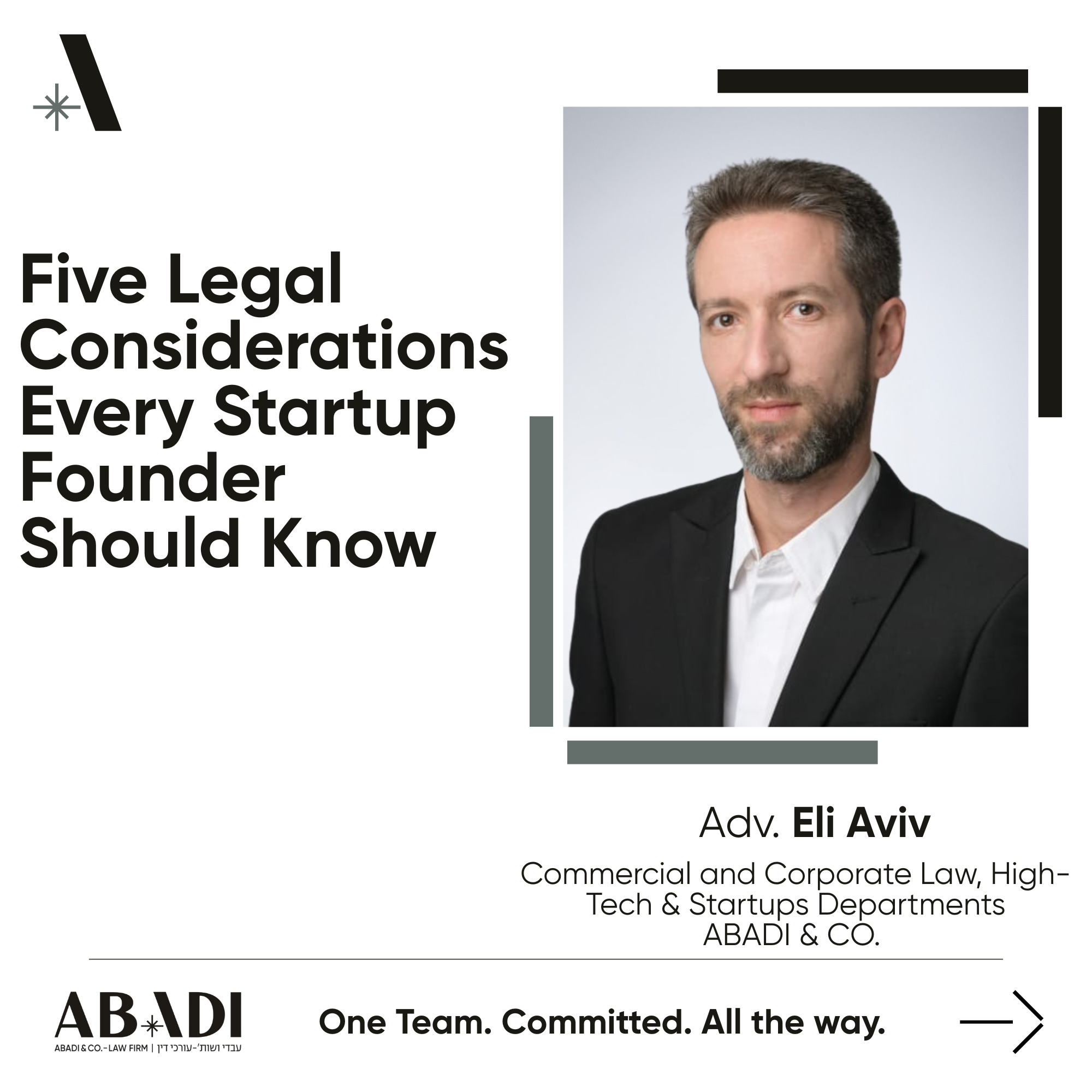
By Advocate Eli Aviv, Commercial and Corporate Law, High-Tech & Startups Departments, ABADI & CO. Law Firm.
Founders are often driven by passion, ambition, and the excitement of building something new. In the rush to develop a product or secure the next round of funding, it is easy to fall into a common trap: believing that "we're friends, everything is working well, and we'll deal with the legal paperwork later, once we have funding or our first investor".
In reality, delaying the legal structuring of a startup is one of the most common reasons that promising ventures fail. Even the strongest business partnerships evolve over time, and without clear legal foundations, internal disputes can derail a company just as it begins to gain momentum. Establishing the right legal framework from the outset is essential.
Below are five key legal considerations every founder should address from the very beginning:
1. Founders' Agreement: The Foundation of Your Partnership
A founders' agreement is far more than administrative paperwork; it serves as a roadmap for the company's governance. Launching a business without one is a significant risk that can lead to costly disagreements down the road.
This is especially important in one of the most common startup scenarios: one founder contributes the technology or business idea, while another provides the initial pre-seed funding. Unless these roles, expectations, and rights are clearly defined from the beginning, conflict is often only a matter of time.
A well-drafted founders' agreement should address, among other things:
- Equity ownership and shareholder protections: Allocation of shares, minority shareholder protections, restrictions on share transfers, rights of first refusal (ROFR), tag-along rights, and preemptive rights.
- Management roles and responsibilities: Clearly define each founder's responsibilities, decision-making authority, and obligations to the company.
- Compensation mechanisms: Establishing how and when founders will be compensated, whether through salaries, dividends, or the repayment of shareholder loans.
- Planning for future investment: Structuring the agreement with future fundraising in mind to help ensure a smoother process when outside investors join the company.
2. Intellectual Property: Where Does the Company's Real Value Lie?
For most technology companies, intellectual property (IP) - the product - is their most valuable asset. One of the first legal issues founders should address is ownership of that IP.
In most cases, all intellectual property should be assigned to the company through an IP Assignment Agreement. However, alternative structures may sometimes be appropriate. For example, a founder may retain ownership of certain IP while granting the company an exclusive or perpetual license to use it.
If ownership is not clearly defined, disputes may arise over the company's technology or future developments, potentially delaying growth, investment, or even the company's ability to operate.
3. Patent Strategy: Turning Innovation into a Competitive Advantage
Once IP ownership has been established, founders should assess whether their innovations are eligible for patent protection.
This decision has important strategic implications. A registered patent can provide significant legal protection and strengthen a company's competitive position for years. At the same time, obtaining and maintaining patent protection is often expensive, particularly for early-stage startups. An effective IP strategy requires balancing commercial value against financial resources.
4. Compliance and Regulation: Understand the Rules Before You Scale
Many startups discover too late that their products are subject to regulatory requirements that were never considered in their business plans.
Whether dealing with privacy laws such as the GDPR, financial regulations, healthcare requirements, or industry-specific licensing obligations, identifying applicable regulations early is critical to avoiding costly setbacks and supporting long-term growth.
5. Defining Your Target Market: A Local Decision with Global Consequences
One of the earliest strategic legal decisions founders encounter is determining the company's target market. Will the company operate solely in Israel, expand globally, or focus on specific regions such as North America or Europe?
The answer affects nearly every legal aspect of the business. It influences regulatory compliance, how intellectual property should be structured, and where patents and trademarks should be registered and protected.
Conclusion
Building a startup is both exciting and challenging. Establishing the right legal foundations from day one is not simply a legal exercise; it is a strategic investment that helps prevent disputes, protects the company's most valuable assets, and allows founders to focus on what matters most: growing their business.
Legal Disclaimer: The information provided in this article is intended for general informational purposes only and does not constitute legal advice, a legal opinion, or a substitute for professional legal counsel. Every situation is unique, and readers should seek qualified legal advice before making decisions that may have legal implications.
