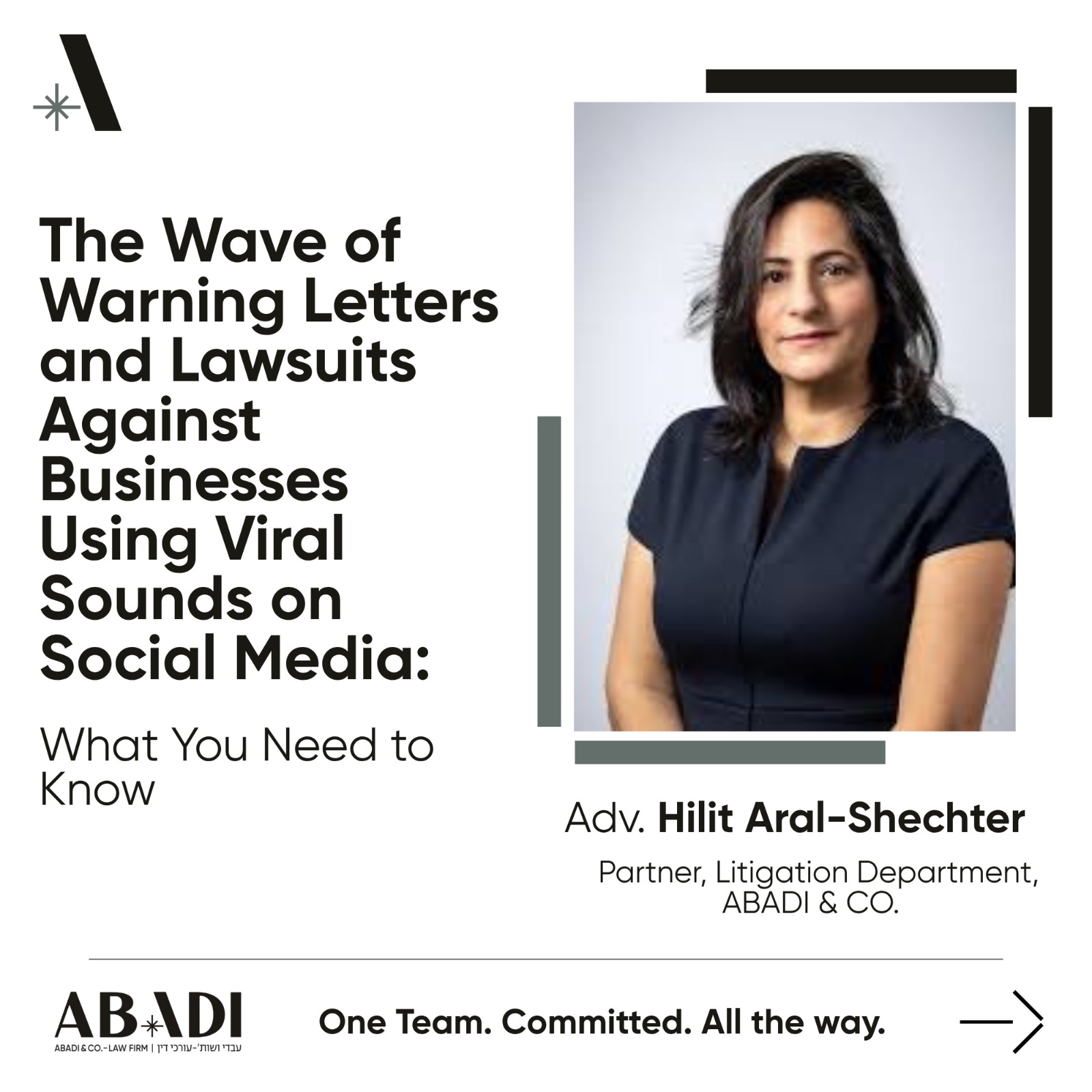
The recent wave of warning letters and lawsuits against business owners who used viral sounds on social media highlights a deeper legal issue. Adv. Hilit Aral Shechter examines the myth of the “10-second rule,” the mechanism of statutory damages without proof of actual harm, and the most effective ways businesses can address this digital trap.
By Adv. Hilit Aral Shechter, Partner in the Litigation Department at ABADI & CO., which represents, among others, companies and business owners in commercial disputes and intellectual property proceedings.
In recent weeks, it has been impossible to ignore the story making waves across social media: a song by the artist known as the “drone boy” went viral, and, according to reports, dozens and even hundreds of warning letters were subsequently sent and lawsuits filed against small business owners who used the sound in their videos.
Beyond the sensational headlines, the affair highlights a much deeper issue in copyright law—one that will remain relevant long after the current trend fades.
Dispelling Common Myths
Many business owners operate on social media based on simple assumptions that are legally incorrect. Here are the key facts to know:
There is no “10-second rule”: Using a protected musical work, even for just a few seconds, may constitute copyright infringement.
Credit is not a license: Giving credit to the creator in a post or video does not make unauthorized use permissible.
A private account does not eliminate liability: Using a personal rather than business account to promote a business does not provide protection against a copyright infringement claim.
A Spotify or Apple Music subscription is not a commercial license: A monthly subscription to these platforms generally grants personal listening rights, not a license to use music in commercial business videos.
A Brief History of Statutory Damages Without Proof of Actual Harm
The most significant tool driving the current wave of lawsuits is the mechanism of statutory damages without proof of actual harm—a longstanding remedy in copyright law. When the Israeli Copyright Law was enacted in 2007, the minimum threshold for statutory damages without proof of harm was eliminated, while the maximum amount was set at NIS 100,000 per individual infringement, subject to the court’s discretion.
Over the years, the legislature has sought to moderate this mechanism in order to prevent abuse. Nevertheless, a business owner who uses a copyrighted work or sound to promote their business may fall outside certain protections established for non-commercial uses.
Recently, in May 2026, a private bill was submitted to the Knesset seeking to limit the use of statutory damages without proof of actual harm, so that actual financial damage would have to be demonstrated in connection with the infringement. However, such a change could also make it more difficult for genuine creators to quantify the harm caused to them and protect their intellectual property.
Old Law Meets a New Digital Reality
The mechanism of statutory damages without proof of harm was developed against a historical premise: a person who uses a work without authorization takes something that belongs to the creator—whether in the form of reputation, profit, distribution, or control.
On social media, however, the reality is more complex. A creator who uploads a song or sound to social media will generally want their content to go viral. The more people who use the sound, the greater the exposure, reputation, and sometimes even direct compensation the creator may receive from the platform.
The platforms themselves may benefit even more. They actively offer viral sounds through their video-upload interfaces, creating the impression among users that such use is permitted. In practice, however, the platforms’ terms of use may shift legal responsibility onto the end user.
This creates a distortion: the creator and the platform benefit from the virality, while the small business owner who, in good faith, clicked “Add Music” may bear the full legal risk.
Theory vs. Practice in the Courts
Although warning letters may demand the maximum amount of NIS 100,000, it is important to understand that this is a theoretical ceiling, not a realistic prediction of the amount that will necessarily be awarded. Courts consider various factors, including the scope of the infringement, the profit generated by the defendant, the actual harm caused, and the defendant’s good faith.
Good faith can carry significant weight. Promptly removing the infringing video upon receiving the initial notice, even before a lawsuit is filed, may reduce the amount of damages and may also affect the economic viability of continuing the proceedings.
So Why Are Business Owners Still So Concerned?
Warning letters remain intimidating, and understandably so. Conducting full legal proceedings involves significant legal fees, even where the eventual damages awarded are relatively low. Plaintiffs are aware of this imbalance, and business owners may therefore prefer to pay a settlement of several thousand shekels rather than engage in a costly legal battle.
What Is the Key to an Effective Response?
When faced with a broad wave of lawsuits based on a similar cause of action, as in the “drone boy” case, the most effective approach may be not to fight alone. Coordinating multiple defendants under joint legal representation can help distribute defense costs and make the legal battle more economically viable.
More importantly, such coordination can shift the balance of power with the plaintiff and demonstrate that they are facing an organized and represented group that does not intend to simply give in.
The message to business owners is simple: the fact that a sound appears on a platform does not necessarily mean that it is licensed for commercial use. Before using viral content for marketing purposes, businesses should verify the applicable usage rights. A brief preliminary check may save them from a complex and costly legal proceeding later on.
About ABADI & CO. Law Firm
ABADI & CO. is a multidisciplinary law firm combining legal expertise, strategic thinking, and a broad business perspective. The firm operates through an integrated model that enables its clients to receive comprehensive support on complex legal, commercial, and regulatory matters. The firm’s Litigation Department represents companies, entrepreneurs, and business owners in commercial disputes, intellectual property claims, and proceedings relating to activity in the digital sphere, providing practical solutions that combine risk management, reputation protection, and the advancement of business objectives.
Legal Disclaimer:
The information contained in this article is provided in summary form for general informational purposes only and does not constitute legal advice, a legal opinion, or a substitute for professional advice tailored to the specific circumstances of any particular case. In any matter involving a legal question or a decision with legal implications, professional legal advice should be sought.
To read the full article, click here.
